
Since its founding in 1894, the Muskoka Lakes Association (MLA) has worked to preserve
Muskoka’s natural beauty and environmental health. For more than 130 years, the organization
has championed environmental protection, often pursuing issues for decades before achieving
meaningful change.
Its accomplishments include educating property owners about septic systems, reducing
steamship pollution, promoting phosphate-free detergents, helping combat acid rain, and
establishing one of Ontario’s most comprehensive volunteer water-quality monitoring programs.
The First 50 Years (1894–1944)
The MLA was founded with a clear mission: “To preserve the healthful sanitation and scenic
beauty of the Muskoka Lakes.”
In 1903, it established a Sanitation Committee, the predecessor of today’s Environment
Committee. At that time, hotels, resorts, steamships, and sawmills routinely discharged garbage,
sewage, and industrial waste directly into Muskoka’s waterways. With few environmental
regulations, the MLA became a leading advocate for cleaner lakes.
Commercial logging caused significant damage. Floating logs disrupted fish habitats, while
sawmills discharged sawdust that smothered spawning grounds. The MLA successfully lobbied
governments to restrict these practices, helping restore fish populations.
Steamships also polluted the lakes with ash, oil, and sewage. MLA advocacy helped secure
requirements for onboard wastewater holding tanks.
The organization also educated cottagers and resorts about proper sewage disposal and septic
maintenance, reducing shoreline contamination decades before modern environmental
regulations existed.
The Second 50 Years (1944–1994)
Following the Second World War, environmental awareness increased, although practices
harmful to lake health remained common. Some cottagers discarded bottles and cans into deep
water, while steamships continued dumping garbage overboard. Bathing, washing dogs, and
doing laundry directly in lakes were widely accepted.
The MLA responded with several important initiatives:
• 1966: Launched its first water-quality testing program.
• 1969: Partnered with Pollution Probe to support a provincial study educating cottagers
about septic systems and pollution prevention.
• 1971: Organized volunteer exchanges of phosphate-based detergents for environmentally
friendly alternatives to reduce algae blooms.
During the 1970s, acid rain emerged as a major threat. Emissions from power plants, industry,
and vehicles produced acidic precipitation that damaged forests and waterways. Some Muskoka
lakes became so acidic that fish, amphibian, and insect populations declined dramatically.
In 1981, the MLA assumed a leadership role in the newly formed Canadian Coalition on Acid
Rain. The coalition sought a 50 percent reduction in harmful emissions through research,
education, fundraising, and political advocacy.
Prominent supporters included Canadian Ambassador Allan Gotlieb, author Margaret Atwood,
and U.S. Senators Ted Kennedy and David Durenberger.
Alan Hutton, former coalition president and MLA Commodore, recalled how members wrote
letters, funded research, and pressured governments throughout the 1980s. Their efforts
contributed to the landmark 1991 Canada–United States Air Quality Agreement.
The acid rain campaign remains among the MLA’s greatest achievements, demonstrating how
local environmental advocacy can influence international policy.
The Past 32 Years (1994–2026)
In 2002, MLA board members Joe Moher, John Mollard, and John Curran, working with Dr.
Neil Hutchinson, established the Water Quality Initiative (WQI), creating an extensive citizenscience
program to monitor Muskoka’s lakes.
In 2007, monitoring expanded to nearshore locations and smaller lakes, where surrounding land
use can significantly affect water quality. More recently, chloride testing was introduced to
measure the impact of road salt runoff.
Today, the Water Quality Initiative:
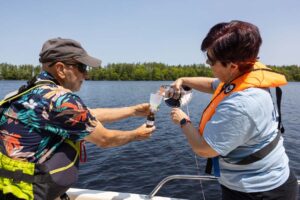
• Engages approximately 100 volunteers.
• Monitors 53 areas across 17 lakes and rivers.
• Collects approximately 700 water samples annually.
• Tests for phosphorus, E. coli, and coliform bacteria while measuring water clarity and
temperature.
• Produces scientific reports through Hutchinson Environmental Sciences, shared with
municipalities, government agencies, and MLA members to inform environmental
decisions.
Deb Martin-Downs, Chair of the MLA’s Environment Committee, emphasizes that everyday
property maintenance matters. Road salt, fertilizers, pesticides, and mosquito-control chemicals
can all affect lake health and wildlife.
The WQI provides valuable scientific evidence to identify emerging threats, track changes in
water quality, and support responsible environmental policies.
Protecting Muskoka for Future Generations
For more than 130 years, the Muskoka Lakes Association has protected the lakes, forests, and
shorelines that define Muskoka. Through advocacy, education, scientific research, and
community involvement, the MLA continues to safeguard this treasured environment.
Please join the MLA and help preserve Muskoka’s natural beauty through water-quality
monitoring, responsible development, and advocacy for fair taxation.